by Alya Alawadhi
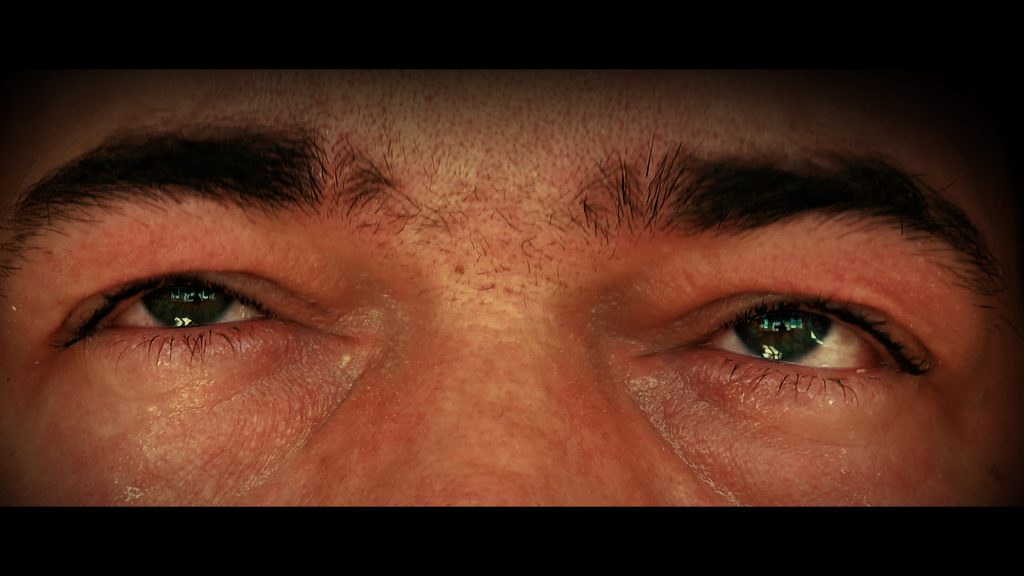
In an intense and prolonged sequence of direct eye contact, Vladimir Mitrev explores the themes of masculinity and heroism. Drawing from what he deems to be one of the greatest scenes in cinematic history, Mitrev borrows a crucial sequence from Once Upon a Time in the West, directed by Sergio Leone in 1968, where the ruthless killer, Frank, and the mysterious protagonist, gunman “Harmonica”, look deeply into each other’s eyes before dueling to the death.
The artist appropriates the scene to investigate the intensity of the direct gaze. By doing so, he topples toxic masculinity on its head and exhibits the immense strength of vulnerability. In the video, the artist maintains eye contact with the viewer for over ten, seemingly excruciating, minutes. Despite being sustained, his gaze is certainly not suspended in time, as the video format emphasizes the duration by allowing the artist’s eyes to tire, well up, and eventually tear. Yet, his raw gaze, in direct contrast to the brief look exchanged between Frank and “Harmonica”, comes across as an act of striking vulnerability: a stripping of all armors and metaphysical barriers blocking him from the viewer.
The only difference between Mitrev’s and Leone’s versions is the duration of the gaze. In the movie, the eye contact is sustained for a few, poignant seconds, during which the characters’ ethical and moral positions are highlighted: “Harmonica’s” heroism is emphasized, while Frank’s cruelty is underscored. Meanwhile, the sheer length of Mitrev’s version allows the inherent violence of the gaze to subvert the pathos of the viewed and convert it into power of the viewer.
Suddenly, it is not just a look exchanged between two people, the recorded stare-off is no longer broadcasting their true colors. Mitrev’s lengthy approach unveils the power the observer holds over the observed and brings our consciousness to the intervening recording device mediating the artist’s gaze. Empowering the distant observer, the camera ultimately throttles the traditional power dynamic of the gaze. Yet, by holding his stare, Mitrev exhibits great strength in navigating this shifting dynamic, redefining our understanding of power and masculinity.
The eyes have long been thought to be windows to the soul. From the Italian Renaissance, which witnessed Leonardo da Vinci’s La Gioconda (1506) and puzzled viewers with Mona Lisa’s tracking eyes, to Salvador Dalí who adapted the eye as a surrealist symbol for that which is invisible, unseen, and – in an allusion to Freudian psychoanalysis – unconscious, artists have consistently payed attention to portraying the eye and depicting the gaze.
In Once Upon A Time, Mitrev engages with this historic discourse and heavily alludes to the eye’s post-modernistic colloquial synonymity Mitrev’s confrontational approach is similar to that of pop artist Andy Warhol, particularly to his invasive 3-minute mug-shot-like recordings of visitors at his studio, a series of almost 500 recordings he had titled Screen Tests (1964–66). For the duration of the 100-foot Bolex film, Warhol asked his subjects to sit as still as possible, even refrain from blinking, studying the effect of the mediating camera – the effect of documentation – on the power of the gaze.
Recorded in a similar fashion, Mitrev’s film can be interpreted as a cropped Warholian “Screen Test”, one which ultimately ponders what happens when one is asked to emulate stillness, project an image of themselves and give into the camera’s recorded gaze.
From: EYE/VIEW exhibition, curated by Andrea Domesle for Videocity / Basel, 2022