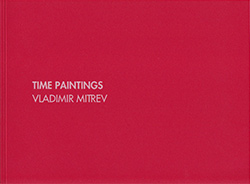
Vlad Mitrev’s Time Paintings: Waiting, Painting: Doing Time
by Sean Silver
The first thing that caught my eye about Vlad Mitrev’s Time Paintings was their audacity. On a purely allusive level, these little blocks of paint offer a striking answer to a basic problem of classical art. Western painting in oils has a long tradition of grappling with a sticky problem: the representation of the fourth dimension in a medium built for two. How is it possible to represent change in a form that makes everything present to the eye, all at once? Because time is essentially a metaphor anyways, various figural solutions have presented themselves. You might think of bearded father time, propped up on a scythe which is meant to remind us of growth and decay. You might think of the meditative heaps of the Dutch Golden Age, the genre pieces and still lifes which show us a clutter of vanities poised just before their decay. Maybe you are reminded of Salvador Dali’s melting clocks, or the fighting Temeraire, being towed to its last berth.
We all know that paint can be made to show time indirectly, as a figure. Mitrev’s bold plan is instead to show us that temporality is essential to the art in the first place, that slow progression is a fact of the art that was there all along. Anyone who has painted even a little bit knows that part of the process is waiting around while paint does what it does. We say that it dries, but really it’s more than this. We might say that it is transforming, irreversibly, from a sticky bulk to a pliable surface, and, like any transformation, in a way that can’t really be forced. Paint dries on its own time, and learning to wait is part of what it means to become a painter.
So, in the first place, the little stepwise gradations of Time Paintings are like invitations to imagine the layers of any painting you please: there is a base layer or starting surface, laid down and allowed to dry. Above it, a first attempt at form, what in another painter might have been an oblong shape to become the outline of a clock or of a face. Above that first try at form, allowed again to dry, is another layer, perhaps yet smaller, now maybe of a rough application of color—with successive layers laid on that, and so, so on and so forth. This is what, in the art, is called “layering”: Mitrev constructs a painting using this basic, temporal aspect of the art as his only guiding principle.
Each of these little squares is a little chemical clock, just like the kind which silently ticks in every painting. But because of the thickness of the application, the process is slowed down enough to watch. The painter waits for weeks, then applies paint, then waits; he can better be said to be a waiter than a painter. Time Paintings catch time in their doing. They congeal it, make it ductile, slow, and heavy. They catch time acting, freezing it or condemning it to a sentence. They do time, and they continue to do time even after they are done, each stepwise block of paint slowly, imperceptibly accreting itself towards mineral earth.
This is why I say that these paintings are ambitious. But they are also playful. Because chemistry is basically unpredictable, because paint at every moment always differs from the way that it was before (and because each batch of paint differs in this way from every other) Time Paintings develop something that can best be called character. Imagine, if you will, the artist, setting off on an adventure and a task, having thought of the concept but not yet laid paint to canvas. He imagines a perfect stair-stepping of paint, as though cut from stone by a CNC router. He is going to show us painting in its perfect essence, painting as the application of surfaces, which he will lay on artificially thick, to draw out this hidden fact of figure.
Years later—I mean, literally years, since each Time Painting takes years to congeal—his idea is no longer just an idea; it is becoming realized. But the canvases have become unruly. They begin to have ideas of their own, with quirks, idiosyncrasies, and desires. Some have opinions; others express what might be called skepticism. He is discovering that paint, even the most stable and ordinary paint—even paint which is just a bit of earth and oil, or oil and metallic oxide—is changeable at its very essence.
The trick is on him.
How is this possible? Mitrev foresaw every eventuality; he bought the paint for the whole painting from the same batch; he stored it carefully, protected from direct sunlight, and so on. But it isn’t coming out the same; it has been changing while he slept. Maybe there was the slightest of undetectable discrepancies in mixture or consistency, which is now showing up as a difference in viscosity. Maybe there was some unimaginable difference between tubes—some chemical residue or effect of shape or pocket of air—which is causing one tube to behave differently than another. Maybe it is just how paint ages. The vintner knows this about the grape: that it knows no timelines of human reckoning. It does not age in any mathematical way, limning a line from sweet to vinegar, say, or light-bodied to full. It tells in its own way.
In this sense, the Time Paintings are like the dig of a geologist, who peels back layers of sediment not in search of some hidden archaeological nugget, but out of love for the very stuff that accompanies the slow layerings of time’s passage. The topographical rendering is not for the topography itself; it is constructed to highlight the differences that have been gathered as if by accident. This is what we call “geological time,” rendered in human scale. So, if you tune your eyes just right, you may (geologist-like) trace in these monochrome blocks the emergence of sheer difference: layers where the paint was pliable to the knife; others, where it began to stick or pull; yet more where it is minimally darker, or lighter, due to the vagaries of the paint, the differences of the paint drying in air or aging in the tube, or maybe in its application in the morning or the afternoon, in spring or fall, June or December.
I said that each of these paintings was a little chemical clock. A more obvious title might have been Time Pieces, reminding us of that other sense of the phrase: a little device that keeps the time. But “painting” has a different virtue. It is a special kind of word, what is called a verbal noun, which means to remember the process that performed an object. When we say that something is a “building,” we mean to remember that it was built. When we say that something is a painting, we should remember that it was painted. But we should also remember that the paint is ongoing: it continues to paint, slowly hardening from the bottom up. Paintings paint—they do what paint does. They continue painting, as paintings, long after the painter has put down his knife. In this sense, these are time pieces that continue to tell, though the time they keep is only their own.
Sean Silver is Associate Professor of Literature at Rutgers, the State University of New Jersey. He has written widely on the literature, philosophy, and sciences of seventeenth- and eighteenth-century Britain. He is author of The Mind Is a Collection (2015), an award-winning exhibit catalogue and virtual museum of objects used to model cognitive processes in 17th- and 18th-century Britain and Europe. Please visit at www.mindisacollection.org. Currently he is working on a cultural history of complexity, a particularly modern way of thinking about the world. Sean Silver has been awarded the ASECS Kenshur Book Prize, and the BSLS Best Book Prize, shortlist, both for The Mind Is a Collection (2016). He has been NOMIS Fellow at Eikones. Center for the Theory and History of the Image, Basel (2018-19), Scholar in Residence at the University of Minnesota, Institute for Advanced Study, (2016-17), and Charles J. Cole Fellow at the Lewis Walpole Library, Yale University (2012-13).
From: Time Paintings. Vladimir Mitrev, ed. by Gallery Marek Kralewski, Freiburg i. Br. 2020, pp. 7–13.